shows
Glass is not equally clean – and PET is worse
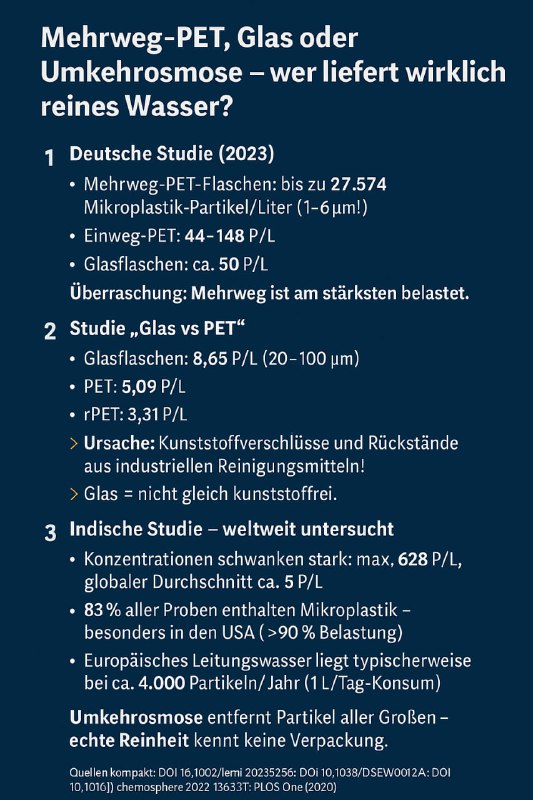
Microplastics in PET, glass, tap water and reverse osmosis - who really delivers pure water?
1. German study (2023)
➤ Reusable PET bottles: up to 27 574 microplastic particles/liter (1–6 µm!)
➤ Single-use PET: 44 – 148 P/L
➤ Glass bottles: approx. 50 P/L
➡️ Surprise: Reusable is most heavily contaminated.
🔗Source
📌 2. Study "Glass vs PET"
➤ Glass bottles: 8.65 P/L (20–100 µm)
➤ PET: 5.09 P/L
➤ rPET*: 3.31 P/L
Cause: Plastic closures and residues from industrial cleaning agents!
❗️ Glass = not necessarily plastic-free.
🔗Source
📌 3. Indian study (2022)
➤ Local brands: 212 ± 100 P/L (>100 µm)
➤ National brands: 72 ± 36 P/L
Children ingest up to 5 186 particles/kg body weight/year when extrapolated!
🔗 Source
📌 4. Tap water – examined worldwide
➤ Concentrations vary widely: max. 628 P/L, global average approx. 5 P/L
➤ 83 % of all samples contain microplastics – especially in the USA (> 90 % contamination)
➤ European tap water typically at approx. 4 000 particles/year (at 1 L/day consumption)
🔗 Source
We conclude:
* Bottled water (PET/glass) releases microplastics in considerable quantities – whether reusable PET, closure plastic or cleaning residues.
* Tap water contains less microplastics, but consistently, ranging from 0 to 600 P/L depending on region.
* Reverse osmosis remains the safest solution: removes particles of all sizes – from nanoparticles through fibers (fiber-like microplastic particles) to fragments and cleaning residues.
For true purity, it doesn't matter where your water comes from – but what is no longer in it.
Reverse osmosis brings clarity where bottles cannot.
A high-quality reverse osmosis filter removes not only microplastics, heavy metals, drug and medication residues – it also ensures that your water is restructured and energized. For everyone who values clean, toxin-free and cell-available water.
*rPET = recycled PET, which has been reprocessed from already used PET products (e.g. used bottles). rPET is often advertised as a more environmentally friendly alternative because it reduces waste. However, studies show: rPET also releases microplastics – and sometimes even more than newly manufactured PET, depending on the manufacturing and cleaning process.
📎 further valuable sources on this topic:
[1]: "Microplastics in tap water: Study provides important advice for home."
[2]: "(PDF) Microplastics in the environment, status report 2019 - Umweltbundesamt.at"
[3]: "(PDF) Microplastic in Drinking Water: A Pilot Study - ResearchGate"
[4]: "New study: Tap water worldwide contains plastic - Utopia.de"
[5]: "Microplastics and nanoplastics in drinking water and beverages"
[6]: "Microplastic contamination of drinking water: A systematic review"
[7]: "Plastic Fibers Are Found in 83% of the World's Tap Water, a New Study Reveals"
[8]: "What happens to microplastics in our body?"
For everyone who values clean, toxin-free and cell-available water, subscribe to
the channel:💧https://t.me/truuinfochannel